
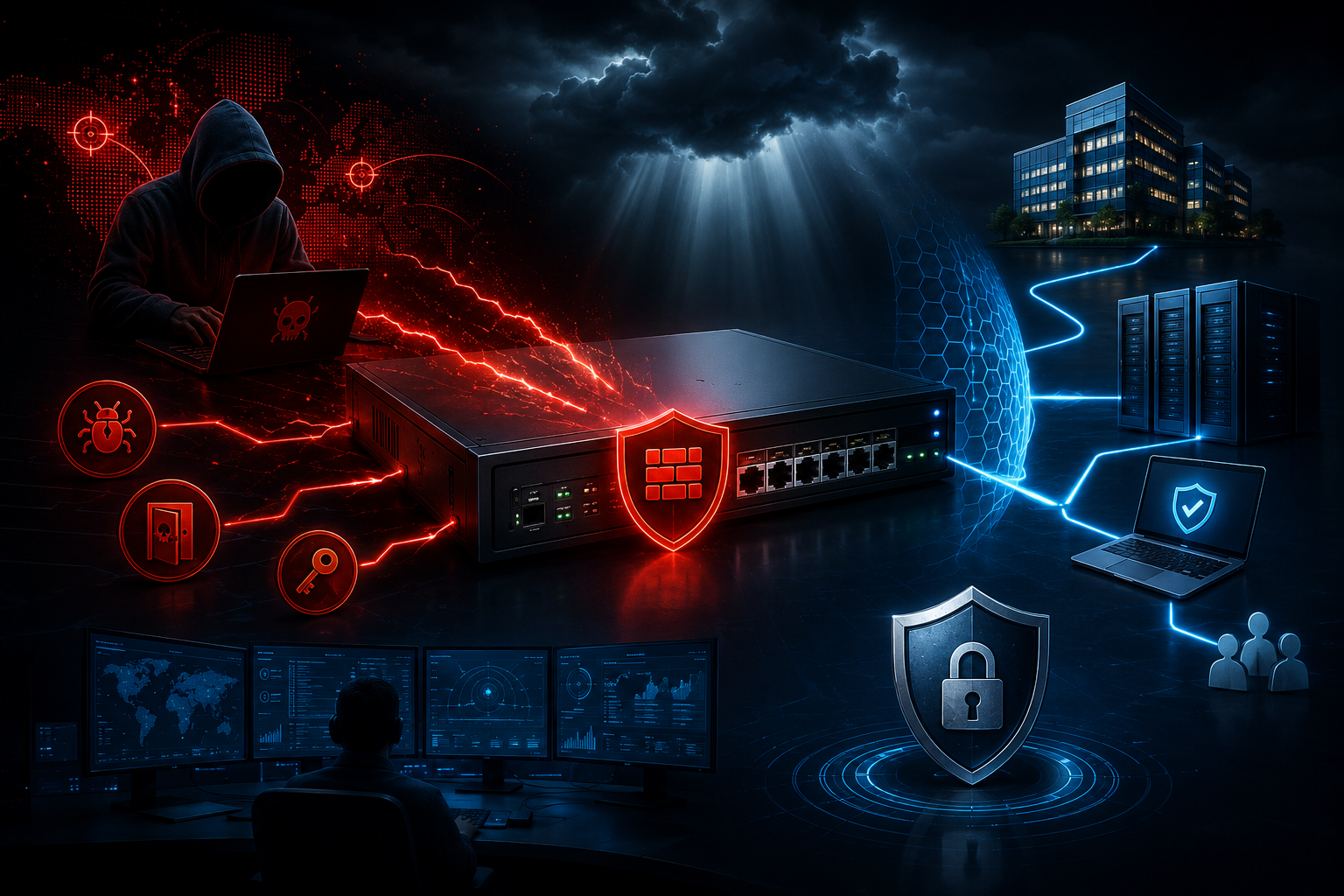
For a long time, the unwritten rule of initial access was simple- trick a human. Phishing and social engineering were the easiest ways into a network because people are notoriously easy to manipulate. While those vectors haven’t gone anywhere, the threat landscape has shifted drastically over the past year. Sophisticated threat actors are completely bypassing the user. Instead, they are going straight for the very hardware deployed to keep them out: perimeter firewalls, edge gateways, and VPN appliances.
It makes perfect sense. Edge devices sit directly on the public internet, exposed 24/7. Because these platforms require deep network integration and high-level privileges to route traffic and enforce security policies, a single unpatched vulnerability can grant an attacker immediate, unauthenticated access straight to the core of a corporate network.
To defend against this, security operations teams need to understand why attackers have shifted focus to edge infrastructure, how they maintain quiet persistence, and what it takes to lock down these perimeters.
The Weaponization of Firmware and Zero-Days
Edge platforms run on proprietary operating systems and specialized firmware. Over the past couple of years, public disclosures of critical edge vulnerabilities have surged across major networking vendors. Advanced persistent threat groups actively watch these disclosures, often weaponizing public exploits within hours of a patch drop. In the worst cases, state-sponsored actors deploy zero-day exploits months before a vendor even realizes a flaw exists.
The real problem for defenders is visibility. Traditional security software (like endpoint detection and response agents) cannot be installed on a proprietary firewall or VPN appliance. Once an attacker exploits an edge device, they are operating in a blind spot. They can execute commands, modify configurations, and establish an initial foothold without triggering any of the standard endpoint alerts that a SOC relies on.
Blending In: “Living off the Land” at the Network Edge
When an attacker compromises a standard Windows workstation, they usually drop malware or remote access trojans. On an edge device, they can take a much quieter approach. Attackers are heavily relying on “Living off the Land” techniques. This means they don’t drop malicious files; instead, they use the built-in diagnostic tools, administrative command-line interfaces, and native scripting capabilities already present within the network operating system.
By using legitimate system tools to create things such as hidden admin accounts, their footprint looks exactly like normal day-to-day administrative activity. This makes traditional signature-based detection completely useless. It’s how attackers manage to maintain access for weeks or months without anyone noticing.
Stealing Keys Right at the Door
Perimeter gateways handle thousands of active sessions and user credentials every day. Attackers targeting these devices frequently focus on memory dumping or exploiting session management flaws to harvest valid active tokens and VPN configurations.
With these stolen credentials, threat actors don’t need to deploy complex malware to move laterally. They can simply log into the corporate environment using a valid, legitimate user session, completely bypassing multi-factor authentication (MFA) prompts that were already satisfied during the initial login. To a SOC analyst looking at a log, this traffic looks like an employee working late, rather than an active network intrusion.
Real-World Defenses for Global SOC Teams
- Enforce Aggressive Perimeter Patching: Treat edge infrastructure updates with the absolute highest priority. Establish an emergency patching workflow specifically for perimeter appliances. If a patch cannot be applied immediately, look for vendor-recommended workarounds or completely restrict administrative access to trusted management subnets.
- Normalize and Aggregate Edge Logs: Ensure that all edge are actively streaming relevant logs to your SIEM. These logs need to be normalized so defenders can clearly track configuration changes, unauthorized CLI access, or abnormal admin logins.
- Pivot to Behavioral Analysis: Focus detection engineering efforts on what happens after an administrative connection is made. Establish a baseline for normal admin behavior (like typical login times and source IP addresses). Look for anomalies, such as an edge device initiating outbound connections to unusual external IP addresses or internal networks where it has no business communicating.
What This Means for DefendEdge SOC and MSSP Operations
As threat tactics evolve to target the network edge, DefendEdge continues to adapt our monitoring and defense models. Our global SOC goes beyond analyzing standard endpoint and user alerts; we maintain deep, continuous visibility into the log signals and configuration baselines of our clients’ edge environments.
Through integrated threat intelligence, automated log normalization, and custom detection rules tailored to network edge anomalies, our analysts are positioned to catch perimeter compromises before an adversary can pivot deeper into the internal network. We work directly with client engineering teams to validate firmware levels, verify policy compliance, and ensure that critical edge infrastructure remains resilient against modern exploitation.
Conclusion
The corporate perimeter isn’t a static wall anymore; it’s a highly targeted, dynamic interface. As threat actors continue to focus their resources on exploiting edge infrastructure and leveraging native system utilities, organizations have to shift from passive perimeter trust to aggressive patch discipline and continuous monitoring. By prioritizing deep log visibility and behavioral analysis, SOC teams can effectively neutralize edge threats and secure the gateway to their digital enterprises.
Leave a Reply