
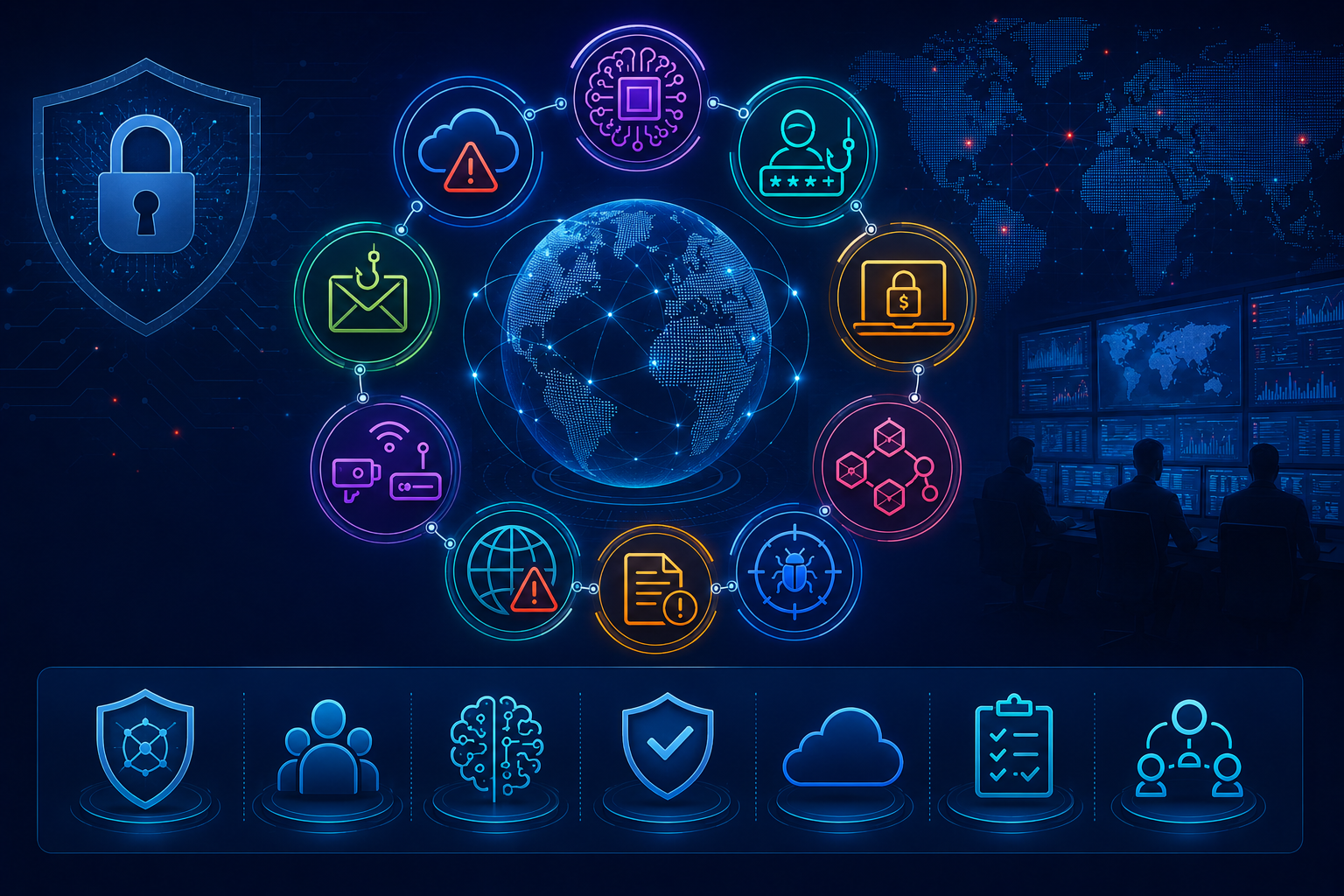
Cybercriminals are leveraging new technologies, targeting new industries, and exposing operational weaknesses. The evolving threat landscape spans healthcare, finance, government, manufacturing, education, and critical infrastructure. No industry is safe from ransomware, supply chain compromise, cloud misconfiguration, social engineering, and nation-state activity.
Global SOC teams need to look beyond detecting the latest threats. Building and scaling a disciplined SOC operating model is equally important. A framework that balances intelligence, endpoint, and network visibility, incident response readiness, governance, and analyst development allows a global SOC to operate intelligently and proactively across distributed clients and time zones.
In this blog, we examine five cyber threat trends and share how global SOC teams can prepare for them through actionable, repeatable, and risk-aligned security operations.
1. Ransomware-as-a-Service Expands the Threat Landscape
Ransomware-as-a-Service (RaaS) has democratized ransomware for threat actors who lack the resources or capabilities to develop their own ransomware kits and infrastructure. Cybercriminals can subscribe to ransomware from more advanced adversaries and receive affiliate access, detailed instructions, payment processing, customer support, customized ransomware variants, and technical support. This business model has fueled ransomware growth across industries, allowing novice attackers to easily launch campaigns.
Attackers are also bundling data theft with their ransom demands, extortion threats, and public-facing leak sites. This trend means ransomware not only creates a data-encryption risk, but also customer, partner, and reputational extortion risk.
How Global SOC Teams Can Prepare
- Monitor for ransomware indicators of compromise (IOCs) and tactics, techniques, and procedures (TTPs) through proactive threat hunting. Hunting methodologies should include unusual file access, privilege escalation attempts, suspicious lateral movement, and command-line activity.
- Ensure adequate endpoint detection and response (EDR) or extended detection and response (XDR) visibility to detect, contain, and analyze ransomware threats early.
- Work with IT and business continuity teams to understand data backup capabilities, restore workflows, and incident recovery timing.
- Implement Zero Trust architecture, minimize unnecessary access, enforce least privilege permissions, apply network segmentation, and deploy multi-factor authentication (MFA). Perform exposure reviews to reduce ransomware risk exposure.
2. Supply Chain Attacks Continue to Pose a Critical Risk
Recent years have shown that trusted third parties can become one of the biggest threats to an organization. Supply chain risk extends to vendors, managed services, software providers, third-party application hosting, outsourced development teams, business partners, and more. Cyber actors that compromise any of these supply chain elements can gain upstream access to a target’s environment. Once inside, threat actors have the opportunity to infiltrate a network, move laterally, pivot to privileged accounts, and remain undetected for extended periods.
For SOC teams, it is important to maintain visibility into supply chain risk exposure. This means you should always know which vendors have access to your environment, where they can access, how their activity is being logged, and how long it takes to revoke access during an incident.
How Global SOC Teams Can Prepare
- Partner with procurement, legal, governance, risk, and compliance (GRC), and IT teams to build vendor risk management standards prior to third-party onboarding.
- Monitor third-party activities, including vendor-created accounts, service integrations, accessible systems, and exposed applications.
- Ensure vendors cannot access unnecessary systems due to network segmentation and least privilege security models.
- Maintain a supply chain-focused incident response playbook that covers isolation, access validation, client communications, and executive escalation.
3. Cloud Security Gaps Are Growing Through Misconfiguration and Identity Exposure
Cloud services have enabled businesses to scale and grow at impressive rates, but they have also increased exposure to cloud misconfigurations and identity risk. Too many cloud storage objects are publicly accessible, permissions are often excessive, strong authentication is disabled, APIs are left open, cloud workloads are not managed properly, and logging is too sparse or unnormalized to serve actionable analysis.
SOC teams need to be aware of the shared responsibility model and ensure cloud-specific monitoring is embedded into detection and response workflows.
How Global SOC Teams Can Prepare
- Prioritize Cloud Security Posture Management (CSPM) and use cloud-native security tools to detect misconfigurations, risky permissions, compliance violations, and exposed data.
- Implement strong identity and access management with MFA, role-based access control (RBAC), conditional access rules, privileged access governance, and routine access reviews.
- Ensure cloud logs are being pulled into your SIEM, XDR, or centralized monitoring solution for detection and analysis.
- Create cloud-specific incident response playbooks for evidence preservation, volatile cloud artifacts, cloud forensics, tenant containment, and exposed data analysis.
4. Social Engineering Attacks Are Leveraging More Sophisticated Tactics
Social engineering and phishing attacks continue to be one of the most successful initial attack vectors for cybercriminals. This is partly because social engineering preys on human nature, and people often struggle to identify cunningly disguised phishing emails. Today’s phishing campaigns are leveraging personalized messaging, business email compromise (BEC), impersonation tactics, QR codes, malicious attachments, fake websites designed to steal credentials, and AI-generated content.
SOC teams must ensure that people, processes, and technology work together to stop phishing emails before they reach end users.
How Global SOC Teams Can Prepare
- Deploy layered email security solutions that can detect malicious attachments, links, spoofed senders, abnormal sender behavior, and authentication failures.
- Provide regular security awareness training to ensure employees understand the latest phishing tactics. Also, ensure employees know how and who to report suspected phishing emails.
- Run routine simulated phishing campaigns to identify which users need additional training. Break down the results by department, job role, office location, and user risk scores.
- Establish an incident response workflow for when phishing emails are detected. This should include mailbox searching, message quarantining, forced password resets, impacted endpoint analysis, and end-user notifications.
5. Nation-State Attacks Require Meticulous Detection and Response
Nation-state adversaries and advanced persistent threat (APT) groups continue to pose a serious cybersecurity risk. Some cybercriminal groups are funded by nation-states or act independently to acquire geopolitical advantages, steal intellectual property, cause critical infrastructure disruption, or disrupt national security efforts. Because of this motivation, nation-state groups may conduct slow and methodical reconnaissance to achieve their goals. They can also use advanced tactics and persistence mechanisms to fly under the radar and mimic legitimate administrative behavior.
Effective detection and response is the best way for SOC teams to defend against sophisticated actors.
How Global SOC Teams Can Prepare
- Actively participate in trusted information-sharing programs. Integrate government, industry, and vendor intelligence into your existing detection processes.
- Employ behavior-based detection to quickly identify anomalies like privilege abuse, uncommon data transfers, unusual file access, suspicious command-line activity, and evidence of cloud abuse.
- Verify that endpoint, network, identity, and cloud signals are being monitored and integrated into a cohesive detection and response platform, such as EDR/XDR or SIEM.
- Test your incident response program with tabletop exercises, purple-team testing, and red-team exercises that mimic nation-state TTPs.
What This Means for DefendEdge SOC and MSSP Operations
As the threat landscape continues to shift and expand, DefendEdge stays focused on building a scalable, risk-aligned SOC and Managed Security Services Provider (MSSP) operations model. Our global SOC team must be equipped to handle security operations across client environments while consistently escalating risk, aligning with NOC, Build, IAM, CTI, and GRC teams, and notifying stakeholders about business-critical risk.
Partnering with MSSP clients should expect us to do more than read, acknowledge, and escalate alerts. We continuously strengthen our monitoring and response workflows to meet client requirements. This includes enhancing analyst training, updating playbooks, and escalating high-risk alerts to leadership and executives before risk becomes exposed across the environment.
To learn more about how DefendEdge monitors for these threats and protects our customers from evolving cybersecurity risks, schedule a meeting with our management team.
Conclusion
Cyber threat actors will continue to find new vulnerabilities, target new industries, and attack with alarming sophistication. However, the fundamentals of a strong SOC defense have not changed. Visibility, intelligence, incident response discipline, governance, and continuous analyst training are crucial to delivering value to MSSP clients and protecting their businesses.
SOC teams that prioritize threat intelligence, endpoint and cloud visibility, incident response preparedness, and analyst development will have an easier time preventing cyberattacks against their customers. At DefendEdge, our mission is focused on keeping organizations prepared and protected from the threats that matter most.